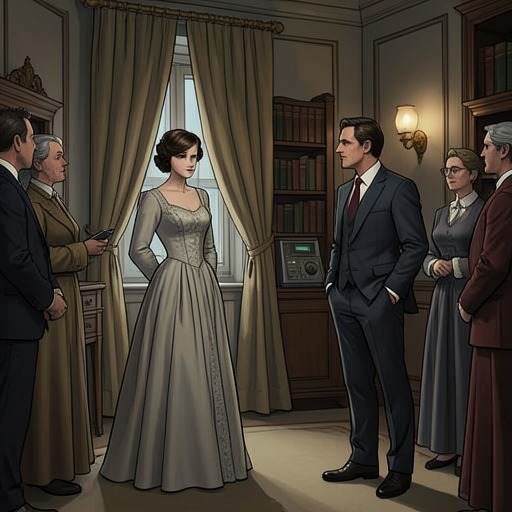
Mila Wizman
Les Choses humainesMila Wizman, the elder daughter of Adam Wizman and Valérie Berdah, grows up amid upheaval that repeatedly unsettles her sense of safety and belonging. The Toulouse school attack, her parents’ separation, her mother’s increasingly strict religious life, and a return from Brooklyn to France all shape the circumstances in which she later encounters Alexandre Farel. In the criminal case that follows, Mila’s account of what happened, and of its continuing consequences, stands against Alexandre’s denial and the public language that diminishes her suffering.
Identity and Background
Mila is the older of Adam and Valérie’s two daughters. The family’s history is marked by the 2012 attack on the Jewish school attended by the girls. After the attack, Adam and Valérie removed their daughters from the school and left France for Israel. The move did not resolve the family’s anxiety: Adam struggled to feel at home there, and the family eventually returned to France. The experience left its mark especially on Mila, whose life and schooling would continue to be affected by the violence and the instability that followed.
Her parents’ marriage also changed the world she had known. Valérie, who began calling herself Sarah, adopted more stringent religious practices. After Adam formed a relationship with Claire Farel and eventually left the family home, the girls’ lives were divided between parents and countries. Mila was particularly vulnerable to the rupture: the attack had already left her struggling, and the separation added another source of distress. Her younger sister followed their mother’s spiritual path more readily; Mila’s response was less accepting.
Life Between France and Brooklyn
After her parents separated, Mila’s mother moved with the girls to Brooklyn, settling in Crown Heights, a strongly religious Jewish neighborhood. Mila found the environment constraining. She objected to the rules governing her clothing and behavior, and described a community where even the shops’ goods reflected religious divisions between girls and boys. When her mother began considering a marriage match for her on the grounds that she had turned eighteen, Mila decided to return to France. She was legally an adult and preparing to retake her baccalauréat as an independent candidate. Adam welcomed her into his home with Claire.
That return put Mila inside a newly assembled family whose members had little shared history. When Alexandre came to the apartment, he and Mila exchanged only a few words. He regarded her and her sister through dismissive stereotypes, while Mila appeared reserved and uncomfortable in the social setting. Claire, for her part, tolerated Mila’s presence but did not try to create an affectionate bond. The household was thus a product of the adults’ new relationship, not a community Mila had chosen or felt part of.
Mila’s school life had once been more settled. A psychologist later told the court that she had been happy in childhood and had done well at school until the attack. Afterwards, her psychological difficulties contributed to her failing her final school examinations; at the time of the events at issue, she was preparing to take them again independently. Her teachers described her as intelligent but troubled by the upheavals in her life. The clinical account presented at trial described her as reserved and introverted, with difficulty expressing emotion, and said she had developed a severe anxiety-depressive condition after the incident involving Alexandre.
The Encounter and Its Consequences
At a party in Paris, Alexandre’s friends set a degrading challenge: each man was to approach a woman and return with an item of her underwear, or face a humiliating online forfeit. The group selected Mila for Alexandre. He did not tell them that she was the daughter of his mother’s partner. He spent time speaking with her, and after she felt unwell and wanted to leave the gathering, he accompanied her outside. The evidence later recounted that he had obtained drugs, and that the two went to a nearby building space, where they used drugs and had sex. He took an item of her clothing as the challenge required and told her afterwards that the encounter had been part of a hazing game. Mila cried. Alexandre left her in the street and returned to the party.
Afterwards, Alexandre tried to reassure himself that alcohol and drugs had affected what happened and that he might have been forceful without intending to be. Yet he remained haunted by Mila’s tears and the possibility that he had gone too far. That uncertainty did not prevent him from leaving France or from later denying her account. For Mila, the effects were lasting. The clinical evidence described an intense psychological reaction, anxiety attacks, nightmares, difficulty going out, and a profound struggle to regain an ordinary life. Her mother, who happened to be visiting Paris when the incident occurred, came to collect her; the family relationship was already strained by the separation and Mila’s decision to return to France.
At trial, the psychologist said Mila had appeared to freeze during the incident and had been unable to defend herself. The witness described her as having a normal personality, not a medical condition that would impair her judgment, while also emphasizing the severity of her distress. Mila’s earlier experiences and family circumstances formed part of that account, but did not erase the distinct consequences attributed to the encounter: her concentration suffered, her daily life narrowed, and the incident became another rupture in an already unsettled adolescence.
Speaking Against Denial
As the trial drew public attention, statements made by Jean Farel were circulated online. The following morning, a newspaper published a manifesto signed by about thirty intellectuals objecting to his description of rape as a brief episode. Mila had also created a blog and published a direct address to Alexandre. She rejected the claim that she had consented, challenged the idea that uncertainty about events could be used as an excuse, and described the fear and distress that led her to report what had happened and undergo medical examinations. Her account also confronted the disparity between Alexandre’s social advantages and her own public portrayal as an academically struggling young woman.
Mila’s intervention made the dispute about more than the competing accounts of one encounter. She argued that talk of a “gray area” could obscure a woman’s refusal and allow a man to avoid responsibility. She also objected to the way Alexandre spoke of his own life as ruined without acknowledging hers. The novel places her public testimony amid a larger argument over who is heard, whose suffering is recognized, and how the language of misunderstanding can minimize harm.
The Trial and Narrative Significance
In her closing address, Mila’s lawyer, Maître Juliette Ferré, framed the civil party’s task as making the court understand Mila’s life since the events of January 11, 2016. She addressed Mila directly, recognizing the difficulty of appearing in court and of repeatedly recounting an experience she wanted to forget. The argument emphasized that the repeated retelling required by legal proceedings could itself renew the pain. It asked the jurors to recognize that shame belonged to the aggressor, not to Mila, and connected the case to the wider public movement for women to speak about sexual violence.
Mila’s role in the novel is therefore not limited to that of a complainant whose account is weighed against Alexandre’s. Her history shows how violence, migration, religious change, parental separation, and the demands of public and legal scrutiny intersect in one person’s life. The testimony and blog give her a voice within a social and judicial setting where others repeatedly describe, interpret, or dispute her experience. The case does not make her distress disappear; it makes recognition of that distress one of the stakes on which the trial turns.